When I was kept awake over the course of an exquisitely intolerable night by the baying of conjunctival hounds in the Thar Desert, I could not have anticipated that two years later I would be writing a glossary for a travel book by a man of the same age, in the same place, but not the same predicament, nearly 150 years ago.
I groggily asked my guide the next morning what all the racket was about. The laconic man replied, as if it was the most natural answer in the world, ‘pigs.’ Pigs? You mean to say that those dogs were howling at pigs? Those porcine creatures that love mud — in the desert? I was too weak with exhaustion and heat stroke to care if he was pulling my leg or not, but the incident was lodged in my brain as one of the more puzzling episodes during my travels.
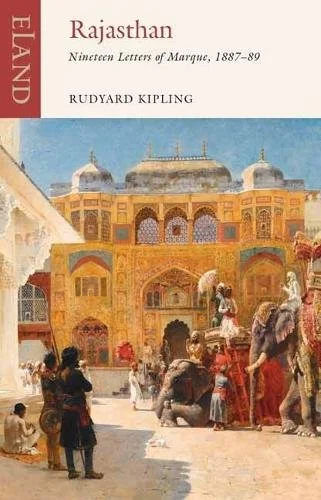
Earlier this year, Barnaby of Eland Books asked me to proofread and provide a glossary of Anglo-Indian words for Rudyard Kipling’s Nineteen Letters of Marque, 1887-1881 (1891; 2026), a series of travel sketches published when he was an up-and-coming journalist. Finally, I thought, a chance to put Hobson-Jobson, the 1886 Anglo-Indian dictionary with an excellent name and even more delectable words therein to work.
Kipling writes with a precocious richesse about historical battles, festivals, and politic machinations which furnished a new depth to my heat-hazy memories of when I stumbled round India’s pink palaces.
The lexis Kipling sprinkles into his account like so many spices would have been instantly understood by the civil servants and military officers who formed the readership of Allahabad’s The Pioneer, a daily broadsheet to which Kipling contributed at just 22 years of age. But the still-impressive number of borrowings found in the English language today (e.g. bungalow, pundit, cushty) pales in comparison to the smorgasbord of courtly, mercantile, and ethnic terms from Hindi, Arabic, Persian, Tamil, and Sanskrit which were in common usage, and indeed invaluable to the organisational machinery of the British Raj.
There are of course words that I stumbled across which deserve to be revived; ‘kos’ for example, used by Kipling in this instance: ‘He had come from some village, with an unpronounceable name, thirty kos away, to see his brother’s son, who was sick in the big Hospital.’ I defined the word as a ‘common unit of measurement, varying by region. From the Sanskrit krośa, ‘a call’, thus the distance is measured by how far a voice can be heard.’ Can English miles or acres compete with such intuitive poetry?
But a little switch flicked in my brain when I read the subtitle of Letter Nine: ‘Of the pig-drive which was a panther killing, and the departure to Chittoor.’ Thence ensues an account of pig-hunting, under the auspices of the Maharana of Udaipur. Old wounds opened up inside me, a gurgling noise emanated from the back of my throat, my nostrils flared in anger. I read without sympathy the line ‘there is something unfair in shooting pigs’ — as long as it makes the dogs shut up, I said to myself, blast away.
Buy the book here.